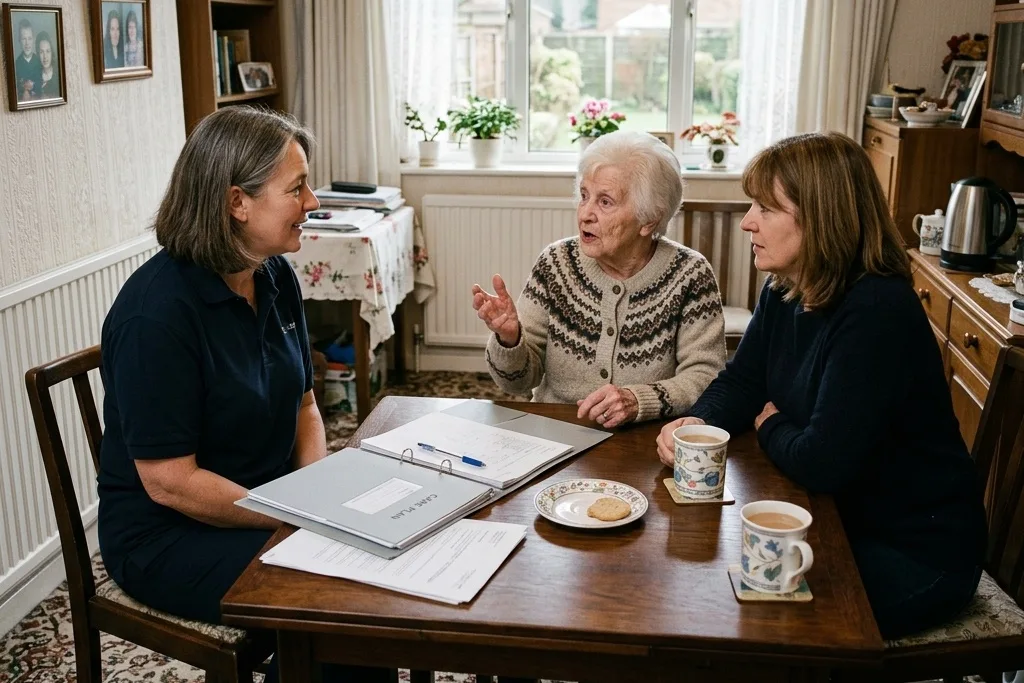
Arranging care for someone is rarely a decision made calmly. Most people reach us after something has changed — a fall, a hospital discharge, or the slow realisation that a parent is not managing.
There are six steps, and you can stop at any of them. Nothing is agreed until you say so, and the first conversation and the visit at home both cost nothing.
Step 1
You get in touch
We answer the phone during office hours; forms are answered the same working day.
Most people ring. Some send the form at eleven at night because that is when they finally had a moment to think about it — either is fine, and both reach the same small team in our Birmingham team.
You will not be asked to choose from a menu of options, and you will not be handed to a different person each time you call back. If you would rather not talk yet, send the form and say so; we will reply in writing.
Nobody is added to a mailing list, and nobody will keep ringing you.
What to have ready
Nothing at all — this is just a first conversation
If you have a rough idea of the times of day that are hardest, that helps
Step 2
We talk it through
Twenty to thirty minutes, on the phone, whenever suits you.
This is the call where we work out whether we are the right people at all. We will ask what has changed, what a difficult day looks like, and what you have already tried. You can ask us anything — costs, notice periods, what happens if it does not work out.
If what you actually need is a district nurse, an occupational therapist or a social care assessment from the council, we will say so and point you to it. We would rather tell you that now than take on care we cannot do well.
There is no charge for this and nothing is agreed at the end of it.
What to have ready
A rough idea of which parts of the day are hardest
Any diagnosis or recent hospital discharge, if there has been one
Whether anybody else is already helping — family, a neighbour, another agency
Step 3
We visit and assess
Usually within two working days of your call. The visit itself takes about an hour.
One of our care managers comes to the house. The point is to see the place where the care will actually happen — the stairs, the bathroom, where the kettle is, which chair is the comfortable one.
We would like the person needing care to be there, and anybody else who is involved in decisions. If that is a daughter on speakerphone from another city, that works too.
We look at what would genuinely help rather than what we would like to sell. Sometimes the answer is two visits a week. Sometimes it is a grab rail and a phone call to the GP.
There is no charge for the visit, and no obligation at the end of it.
What to have ready
Any medication, so we can see what is being taken and when
Details of any equipment already in the house — a hoist, a stand aid, a profiling bed
Anyone else who should be part of the decision
Step 4
You get a written plan
Within two working days of the visit.
You get it in writing: which tasks, on which days, at what times, and the cost per week with nothing hidden behind it.
It also records the things that are easy to forget and matter every day — which side of the bed he gets out of, that she takes her tablets with orange juice and not water, that the radio goes on before anything else happens.
Read it. Change it. Show it to whoever you want to show it to. It only becomes real when you say so, and it stays yours to change afterwards.
What to have ready
Time to read it properly — there is no rush
Anybody else who should see it before you agree
Step 5
We match the carers
Before care starts. Introductions are arranged around you.
We build a small regular team around each person rather than sending whoever happens to be free. Personal care depends on trust, and trust does not survive a different stranger every morning.
You meet them before they start. If somebody is not right — and you do not have to explain why — we change them.
Preferences about the gender of a carer are recorded as a requirement, not as something we will try to accommodate. Every carer is DBS checked and trained on any equipment in your home before their first shift.
What to have ready
Any preference about the gender of the carer
Anything about the household a new person should know — a nervous dog, a difficult front door
Step 6
We keep checking
A call after the first week, a visit at six weeks, then every six months.
The first week is the one that matters. We ring you at the end of it to ask what is working and what is not, because the plan written on paper never survives contact with a real week entirely intact.
After that a care manager visits at six weeks and then every six months, and any time something changes — a fall, a hospital stay, a new diagnosis.
You can change the plan whenever you like, including reducing it or stopping. There is no minimum term.
What to have ready
Nothing — we come to you
Ready when you are
There is no obligation at any point, and the first conversation and the visit both cost nothing. If you would rather talk it through before anything else, call us.